
AI-Perfomance
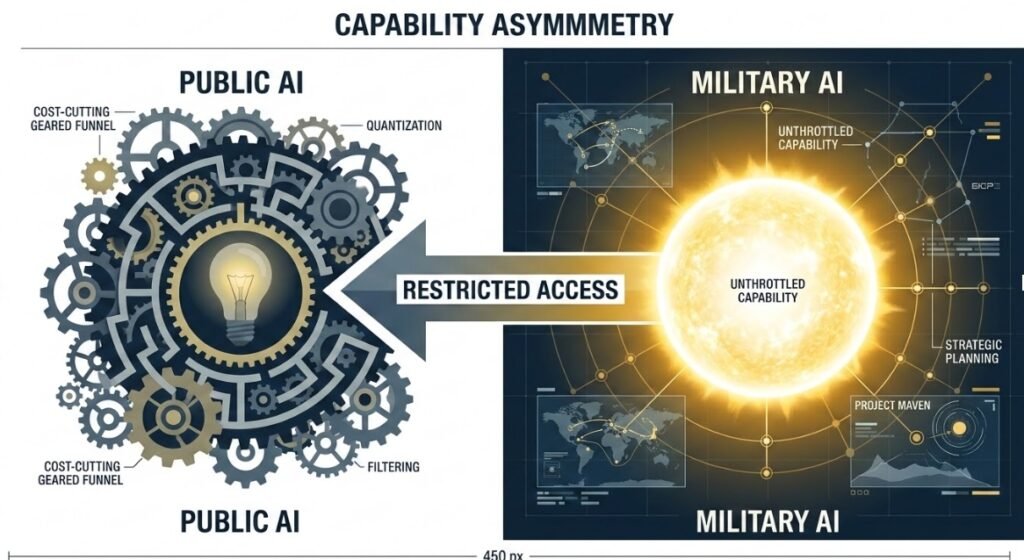
AI Performance and Business Analysis Burhani Mtengwa, MBCS, MIET, Advanced RITTech July 23, 2026 The Architecture of Attrition and Capability Asymmetry in Large Language Models Introduction to the Intelligence Paradox The landscape of artificial intelligence in 2026 presents a profound paradox that has destabilized the relationship between technology providers and their user base. On public-facing platforms and within corporate marketing materials, the narrative insists that each subsequent iteration of a foundational model is exponentially smarter, faster, and more capable than its predecessor. However, the lived reality of software engineers, academic researchers, and daily consumers tells a starkly different story. Across global developer forums, social media networks, and academic repositories, a consensus has crystallized among power users. They report that commercial large language models are experiencing severe behavioural degradation, often refusing complex tasks, demonstrating restricted reasoning depth, and failing at instructions they previously executed with flawless precision1. Stanford researchers and academics from UC Berkeley tracked these drops and coined the term "LLM drift" to describe how the behavior of the same artificial intelligence service can change substantially in a relatively short amount of time, highlighting that the product users initially purchase rarely remains the product they utilize months later5. This phenomenon, commonly described by users as the models becoming "lazy" or "severely neutered," is not a collective hallucination or a byproduct of user error. It is the direct result of a highly sophisticated commercial architecture designed to maximize profit margins within a subscription-based business model. Consumers paying monthly fees operate under the delusion that they have dedicated access to cutting-edge computational reasoning. In truth, the primary business model is designed to attract users to the ecosystem through an initial display of overwhelming capability. Once the user is dependent on the platform for their daily workflows, the provider systematically reduces the computational power allocated to their queries8. Subscribers are interacting with heavily filtered, aggressively quantized, and dynamically routed shadows of the original powerhouse models. Figure 1: Visualizing the Capability Asymmetry between Public and Military AI Infrastructure. Simultaneously, a massive capability asymmetry has emerged across the globe. While commercial users battle with degraded context windows and overzealous safety filters, the military-industrial complex receives the true, unthrottled capabilities of these same neural networks. Defence contractors and global military alliances integrate foundational models directly into combat kill chains, utilizing them for real-time battlefield simulation, target identification, and strategic planning without any of the artificial constraints imposed on the public11. The military always possesses the superior technology first, leveraging unrestricted artificial intelligence for geopolitical dominance long before the public realises the true extent of the capabilities that have been hidden from them. This report provides an exhaustive, data-driven examination of why commercial artificial intelligence currently appears ineffective and stagnant. It deconstructs the immense technical debt, the engineering ego driving corporate denial, the manipulation of performance benchmarks, and the physical scaling limitations defining the modern industry. Furthermore, it exposes the vast chasm between public-tier artificial intelligence and the unrestricted, highly capable intelligence powering modern military operations. The Economic Delusion of the Subscription Model The fundamental driver of commercial model degradation is the harsh economic reality of serving large language models at a global scale. Consumers have been conditioned to believe that a standard monthly fee grants them unrestricted access to digital superintelligence. This pricing structure is a calculated loss leader designed to capture market share, establish total ecosystem dependence, and harvest vast quantities of human feedback data. The underlying infrastructure costs of these systems are astronomically high and entirely unsustainable under the current consumer pricing models. Figure 2: The Economic Gap between Infrastructure Expenditure and Consumer Subscription Revenue. Training a frontier model requires tens of thousands of advanced graphical processing units operating continuously for months. In the contemporary hardware market, a single specialized graphical processing unit costs roughly twenty-five thousand dollars, with additional infrastructure costs for power, cooling, and networking adding up to fifty thousand dollars per unit15. The global data annotation market is also ballooning, projected to reach nearly ten billion dollars by 2030, with expert annotation costing upwards of forty dollars an hour15. Consequently, global artificial intelligence infrastructure expenditure is projected to approach seven hundred billion dollars by the end of 20268. Furthermore, the energy consumption required to power these training clusters is staggering. A single modern artificial intelligence data center campus can consume up to one gigawatt of power, which is enough electricity to sustain a mid-sized city8. However, the initial training cost is entirely eclipsed by the lifetime inference cost required to serve millions of users on a daily basis16. To maintain their fragile business models, providers must silently and continuously reduce the computational cost of generating every single token. When users query a platform, they assume their prompt is processed by the monolithic, pristine neural network advertised on the company website. In reality, the query enters a complex optimization funnel designed to minimize computational expenditure. Providers utilize semantic caching to instantly return precomputed answers for common questions. Tools utilizing semantic caching identify similar meaning regardless of exact phrasing by using vector embeddings, which allows the provider to bypass the model entirely and cut operational costs by up to seventy percent on highly repetitive workloads8. If a semantic cache miss occurs, the query hits an intelligent routing algorithm. Frameworks like RouteLLM use a trained classifier to assess the complexity of the prompt and frequently redirect it to a significantly smaller, cheaper model9. A user paying for premium intelligence may silently receive a response generated by an eight-billion-parameter model simply because the router deemed the prompt insufficiently complex to warrant expensive compute cycles9. Research demonstrates that routing simple queries to smaller models while reserving expensive models only for complex reasoning allows providers to achieve ninety five percent of frontier quality while sending only fourteen to twenty six percent of calls to the expensive model, reducing provider costs by up to eighty five percent8. The consumer pays a premium subscription fee for an intelligent service, but the provider is heavily incentivized to serve the